Thick earthen walls
Born in Rajasthan, Kutch, Iran, North Africa, Spain, the Americas.
How it works
High-thermal-mass walls absorb the day's heat slowly and release it at night, time-shifting the temperature so the interior peaks long after the afternoon and stays mild, the classic hot-desert answer.
Where it came from
Ramming moist earth between forms is a world technique: sections of the Great Wall, the kasbahs of Morocco, dzongs in Bhutan, and farmhouses from Lyon to Bhuj all stand in rammed earth. It is enjoying a serious contemporary revival wherever low-carbon mass walls are wanted.
How it is built
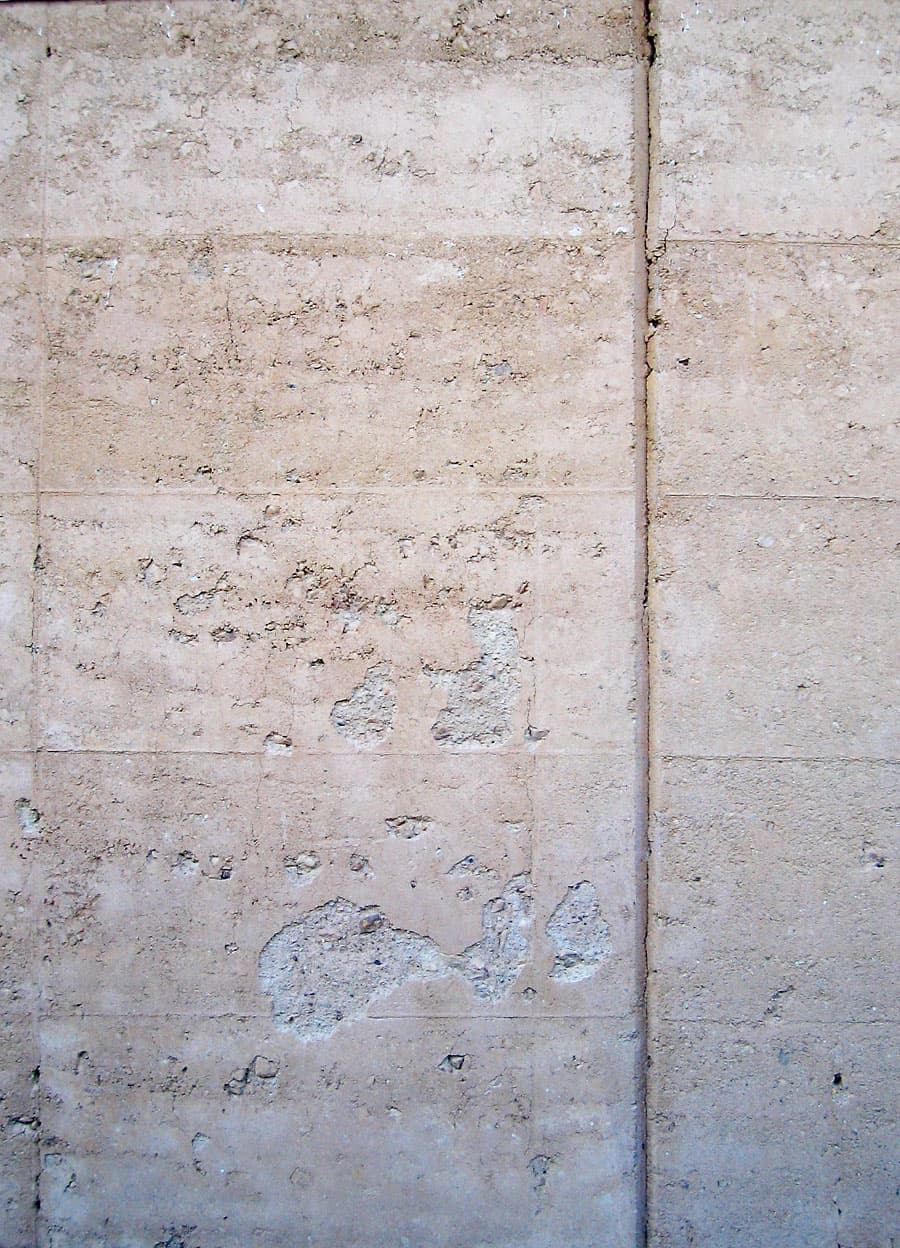
A soil with the right sand-silt-clay balance is moistened, placed in shutters in 10 to 15 centimetre lifts, and compacted until it rings; the formwork climbs and the strata of each lift stay visible as the wall's signature. A good hat (generous eaves) and boots (a raised plinth) protect the wall from rain; modern practice sometimes stabilises with a small fraction of lime or cement.
In a modern home
Rammed-earth or stabilised mud-block walls, insulated high-mass cavity walls, exposed internal mass with night-flush ventilation.
What it answers
Built from
Go deeper
- Gernot Minke, Building with Earth: Design and Technology of a Sustainable Architecture (2006)
- Auroville Earth Institute, technical publications on raw earth construction
Source
Thermal-mass time-lag in Givoni's bioclimatic comfort model; rammed earth documented across Rajasthan, Kutch and worldwide.