Windcatcher
Born in Persia (Yazd, Kashan, Nain), Gulf, Pakistan, NW India.
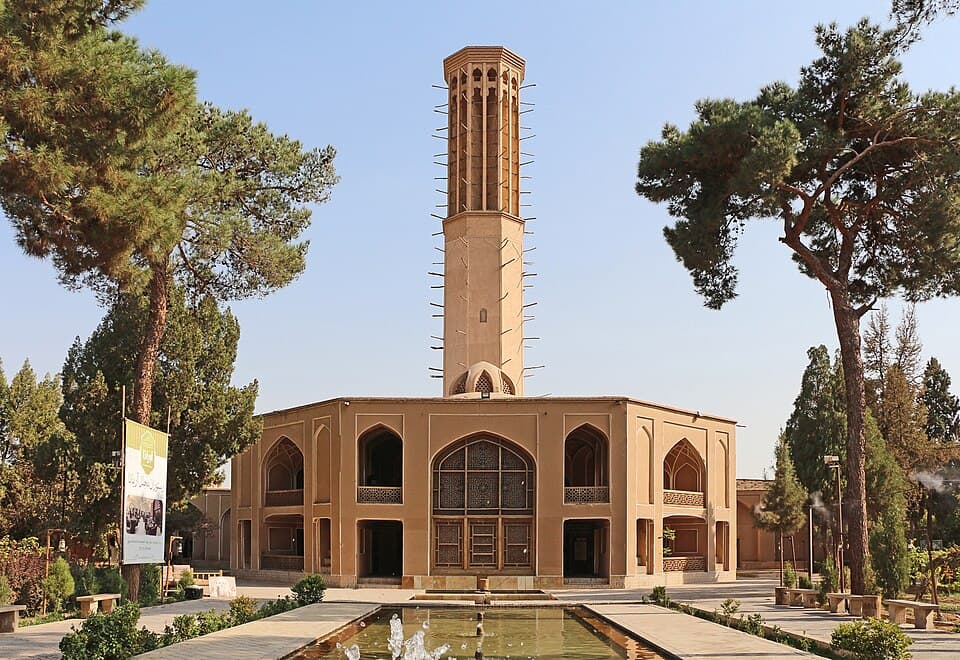
How it works
A tower above the roof catches prevailing wind and funnels it down into the rooms; when the air is still, sun-heated tower walls drive air upward, pulling cool air up from the courtyard and basement (the stack effect).
Where it came from
The windcatcher's heartland is the Iranian plateau, where Yazd earned the nickname shahr-e badgirha, the city of windcatchers. Towers appear in Persian miniatures and travellers' accounts from at least the medieval period, and related wind scoops (the malqaf) are drawn on Egyptian houses millennia earlier. The tallest surviving badgir, at Yazd's Dowlatabad garden, stands about 33 metres.
How it is built
A masonry tower of mud brick or fired brick rises past the roofline, its head open on one, four, or eight sides toward the useful winds. Inside, brick or timber partitions divide the shaft into channels: windward channels press air down into the rooms, leeward ones let warm air escape. The finest examples open into a basement or over a water channel, so descending air arrives pre-cooled.
In a modern home
Rooftop ventilation shafts or solar-assisted stack vents; wind scoops on apartment roofs; orienting the tallest opening toward the summer breeze.
What it answers
Go deeper
- Susan Roaf, 'Badgir', Encyclopaedia Iranica
- Hassan Fathy, Natural Energy and Vernacular Architecture (1986)
- Mahnaz Mahmoudi, Analysis on Iranian Wind Catcher and Its Effect on Natural Ventilation (2010)
Source
Susan Roaf, 'Bādgīr', Encyclopaedia Iranica; Yazd is nicknamed šahr-e bādgīrhā, 'the city of windcatchers'.