Courtyard stack ventilation
Born in Persia, Arab world, China (siheyuan), India (haveli, nalukettu), Mediterranean.
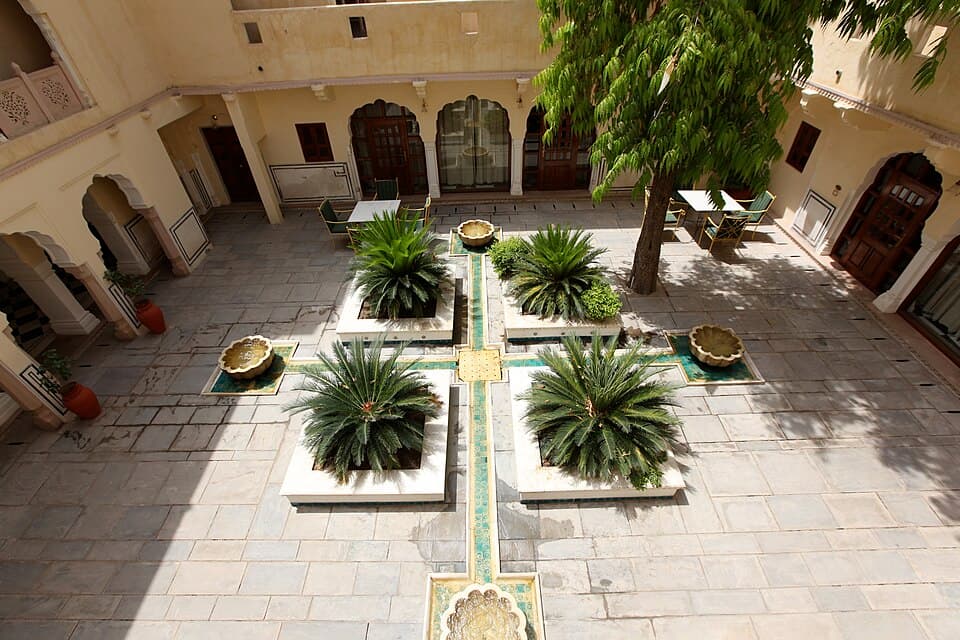
How it works
The shaded courtyard collects dense cool night air; by day, hot air rises out of the open top while cooler court air is drawn into the surrounding rooms. A lung and a thermal buffer at once.
Where it came from
The courtyard house is one of humanity's oldest climate machines, visible in the excavated homes of Ur and Mohenjo-daro and continuous through the Arab riad, the Chinese siheyuan, the Rajasthani haveli, and Kerala's nalukettu. Every tradition discovered the same physics independently: a shaded void at the heart of the house that breathes.
How it is built
The court's proportions do the work. Keep it tall and narrow relative to its width and the floor stays shaded through the hot hours while the sky above stays open for night radiation. Overnight, cool dense air pools in the court and feeds the rooms; by day, sun heats the court's upper air and pulls a slow draught up and out, drawing fresh air through the rooms (the stack effect).
In a modern home
Internal light-and-air wells, double-height shaded atria, ventilation courts in apartment blocks; even a small shaded cut-out changes airflow.
What it answers
Go deeper
- Hassan Fathy, Natural Energy and Vernacular Architecture (1986)
- Arvind Krishan (ed.), Climate Responsive Architecture: A Design Handbook for Energy Efficient Buildings (2001)
Source
Soflaei et al. (2017), comparison of Iranian and Chinese courtyard houses; nocturnal ventilative + radiative cooling is well measured.