Perforated stone screen
Born in India (Rajasthan, Mughal).
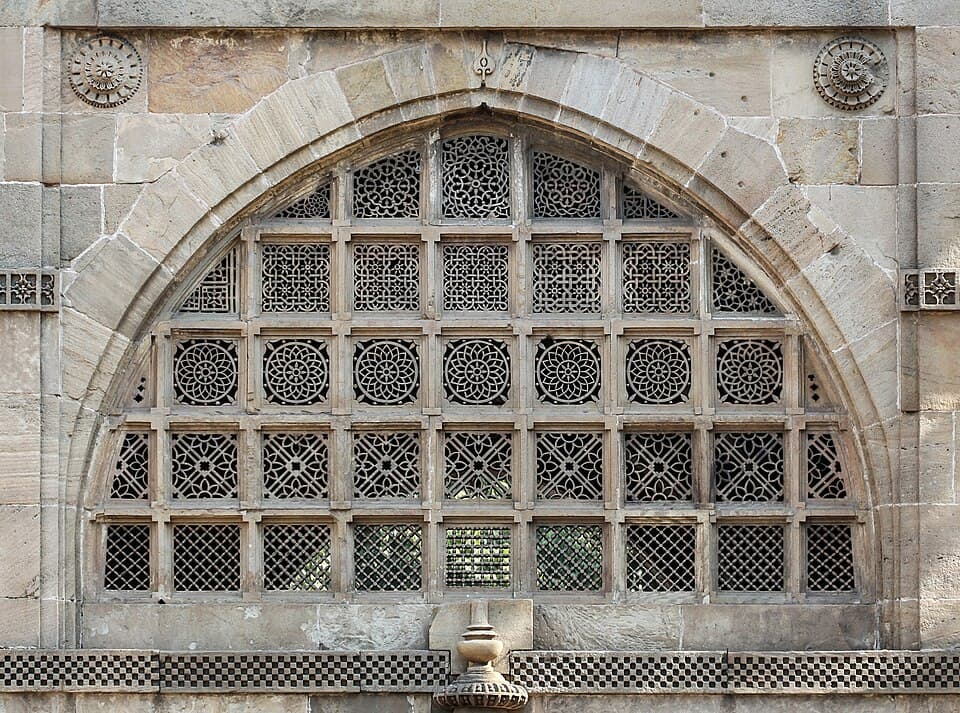
How it works
A carved stone or wood lattice. Air squeezing through many small holes speeds up and cools slightly (the Venturi effect), pushing a breeze through while the screen blocks direct sun and softens glare.
Where it came from
Perforated stone screens run through Indian building from early temple lattices to their high point under the sultanates and Mughals. The Sidi Saiyyed mosque screens in Ahmedabad (1573) and the marble jaalis of the Taj Mahal made the form famous; havelis across Rajasthan and Gujarat used humbler versions on every street face.
How it is built
A single slab of sandstone or marble is marked with a geometric or floral grid and carved through by hand, leaving a web of small openings. The slab's thickness matters: each opening becomes a short duct, so air squeezing through speeds up (the Venturi effect) while direct sun is broken into diffuse light. Modern equivalents cast the same logic in terracotta, CSEB, or CNC-cut panels.
In a modern home
Jaali partition walls, perforated brick screens, CNC-cut metal façade panels for shaded daylight and airflow.
What it answers
Go deeper
- Ebba Koch, Mughal Architecture: An Outline of Its History and Development (1991)
- Studies of perforated screens and airflow in Building and Environment (CFD literature on jaali geometry)
Source
Patwon Ki Haveli and the Jaisalmer havelis are the canonical study cases.