Kutch circular mud house
Born in Kutch, Gujarat.
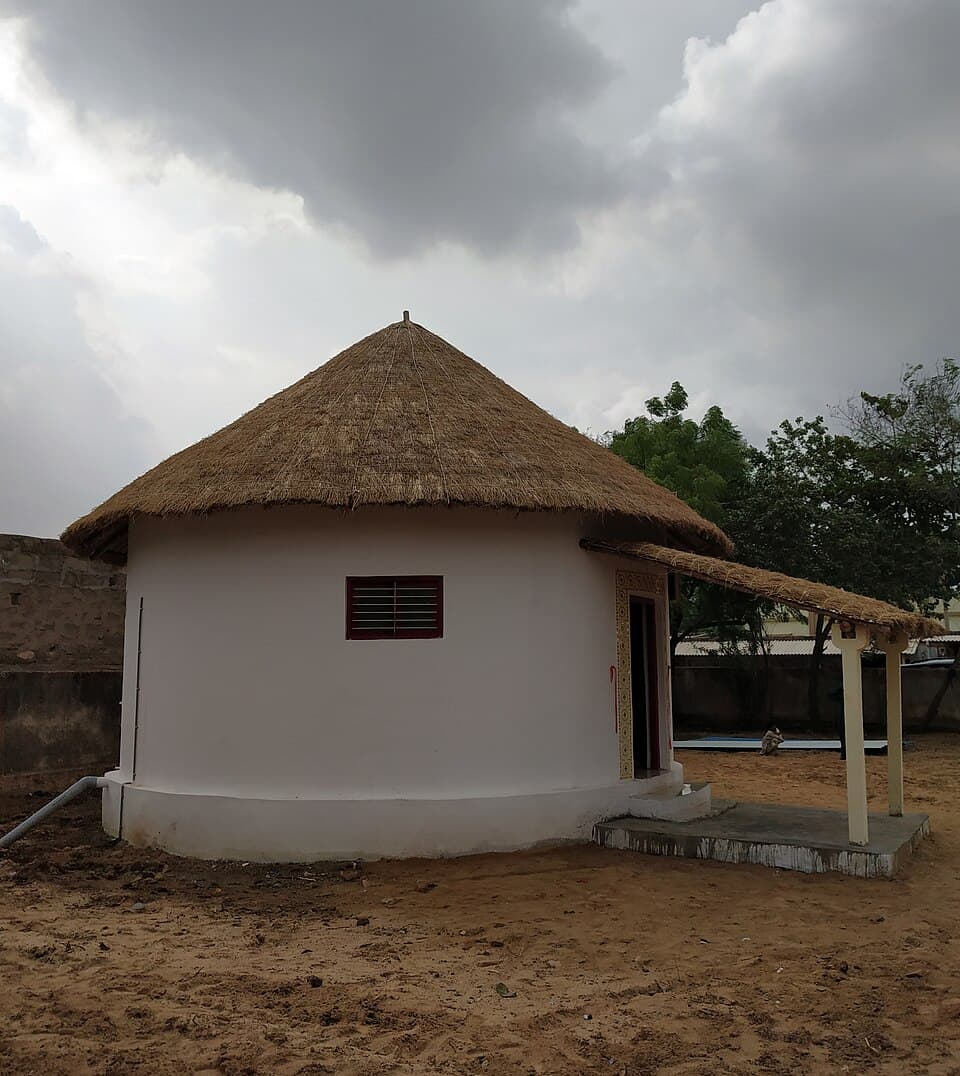
How it works
Thick circular earthen walls give insulation and thermal mass; the round form has no weak corners, so it also resists earthquakes and desert windstorms, a rare two-in-one.
Where it came from
The circular mud houses of Kutch's Banni grassland have sheltered pastoral communities for centuries in one of India's harshest hot-arid zones. The 2001 Bhuj earthquake turned them into a case study: the round, low, lightweight form rode out shaking that flattened newer construction, and post-quake rebuilding deliberately returned to the bhunga.
How it is built
A single circular room, typically three to six metres across, is raised in mud (cob, adobe, or wattle and daub) on a raised earthen plinth, capped with a conical thatch roof on a light timber cone. The circle has no weak corners in a quake and the least wall area per floor area under the desert sun; women finish interiors with lippan mud-and-mirror relief work.
In a modern home
High-mass insulated envelopes; the round / curved-wall lesson for combined seismic and thermal performance.
What it answers
Built from
Go deeper
- Hunnarshala Foundation, Bhuj: documentation of Kutch vernacular and post-2001 reconstruction
- V. S. Pramar, Haveli: Wooden Houses and Mansions of Gujarat (1989), on regional building craft context
Source
Many bhungas survived the 2001 Bhuj earthquake.