Mass + collective resilience
Born in Fujian, China (Hakka).
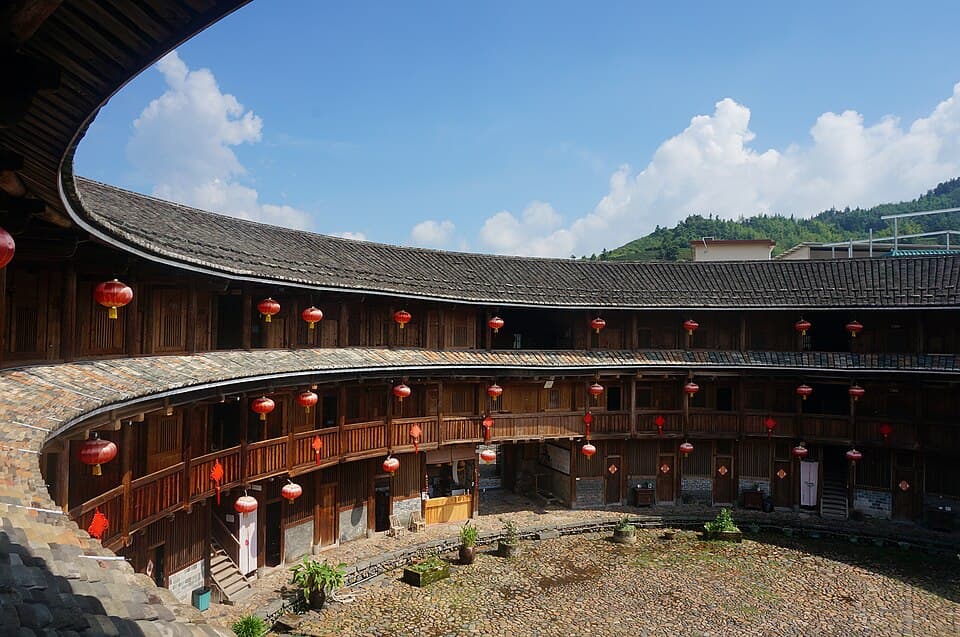
How it works
A multi-storey rammed-earth ring around a central court, thick walls give thermal buffering and structural robustness, housing a whole clan as a self-contained unit.
Where it came from
The Hakka people of Fujian raised fortified earthen ring houses from roughly the 12th to the 20th century; forty-six of them entered the UNESCO World Heritage list in 2008. A single tulou houses a whole clan, some holding hundreds of people behind one gate.
How it is built
Perimeter walls one to two metres thick are rammed from local earth mixed with lime and sand, laid in lifts over a stone base, and reinforced with bamboo strips and timber laths buried in the wall. Inside, three to five storeys of timber galleries face a communal court. The enormous earth mass flattens both daily and seasonal temperature swings.
In a modern home
Perimeter-block-around-shared-court typology; high-mass communal housing (a model for Pada Society).
What it answers
Built from
Go deeper
- UNESCO World Heritage listing, Fujian Tulou (2008)
- Ronald G. Knapp, China's Old Dwellings (2000)
Source
Fujian tulou, UNESCO World Heritage (2008): rammed-earth thermal mass and communal form.